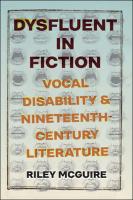
| Judul | Dysfluent in Fiction : Vocal Disability and Nineteenth-Century Literature / Riley McGuire |
| Pengarang | McGuire, Riley |
| Penerbitan | The Ohio State University Press, 2025 |
| Deskripsi Fisik | 226 p. |
| ISBN | 9780814215869 |
| Subjek | LITERATURE |
| Catatan | In Dysfluent in Fiction, Riley McGuire unspools a literary history of vocal disability in the nineteenth century, arguing that this underexamined literary trope helps us to understand vocal hierarchies that still structure our present. Adopting the term “dysfluency” to show departure from normative expectations of pace, pitch, and fluency, McGuire reveals how dysfluent speech populates an enormous number of nineteenth-century texts and played a formative role in the lives of some of the period’s most influential writers. Dysfluent in Fiction examines anglophone literature during the long nineteenth century in both England and America by authors such as William Makepeace Thackeray, Charlotte Brontë, Lewis Carroll, Mary Elizabeth Braddon, and Frederick Douglass. Examples of dysfluencies across genres include lisping lovers, a baby-talking fairy, a mute detective, various disabilities in narratives of enslavement, and more. These representations show how disabled speech was both stigmatized and celebrated in way |
| Bentuk Karya | Tidak ada kode yang sesuai |
| Target Pembaca | Tidak ada kode yang sesuai |
| Lokasi Akses Online |
https://library.oapen.org/bitstream/handle/20.500.12657/101420/external_content.pdf?sequence=1&isAllowed=y |
| No Barcode | No. Panggil | Akses | Lokasi | Ketersediaan |
|---|---|---|---|---|
| 223426192 | 810 Mcg d | Baca Online | Perpustakaan Pusat - Online Resources Ebook |
Tersedia |
| Tag | Ind1 | Ind2 | Isi |
| 001 | INLIS000000000166787 | ||
| 005 | 20260212114420 | ||
| 007 | ta | ||
| 008 | 260212################|##########|#|## | ||
| 020 | # | # | $a 9780814215869 |
| 035 | # | # | $a 0010-0226000727 |
| 082 | # | # | $a 810 |
| 084 | # | # | $a 810 Mcg d |
| 100 | 0 | # | $a McGuire, Riley |
| 245 | 1 | # | $a Dysfluent in Fiction : $b Vocal Disability and Nineteenth-Century Literature /$c Riley McGuire |
| 260 | # | # | :$b The Ohio State University Press,$c 2025 |
| 300 | # | # | $a 226 p. |
| 505 | # | # | $a In Dysfluent in Fiction, Riley McGuire unspools a literary history of vocal disability in the nineteenth century, arguing that this underexamined literary trope helps us to understand vocal hierarchies that still structure our present. Adopting the term “dysfluency” to show departure from normative expectations of pace, pitch, and fluency, McGuire reveals how dysfluent speech populates an enormous number of nineteenth-century texts and played a formative role in the lives of some of the period’s most influential writers. Dysfluent in Fiction examines anglophone literature during the long nineteenth century in both England and America by authors such as William Makepeace Thackeray, Charlotte Brontë, Lewis Carroll, Mary Elizabeth Braddon, and Frederick Douglass. Examples of dysfluencies across genres include lisping lovers, a baby-talking fairy, a mute detective, various disabilities in narratives of enslavement, and more. These representations show how disabled speech was both stigmatized and celebrated in ways that clarify our contemporary response to the spectrum of human articulation and that are a vocal corollary to current notions of neurodiversity. Dysfluency’s power, McGuire contends, lies in its denial that a single mode of articulation is possible, let alone desirable. |
| 650 | # | # | $a LITERATURE |
| 856 | # | # | $a https://library.oapen.org/bitstream/handle/20.500.12657/101420/external_content.pdf?sequence=1&isAllowed=y |
| 990 | # | # | $a 223426192 |
Content Unduh katalog
Karya Terkait :