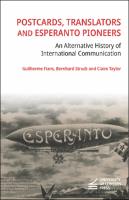
| Judul | Postcards, Translators and Esperanto Pioneers : An Alternative History of International Communication / Claire Taylor; Guilherme Moreira Fians |
| Pengarang | Taylor, Claire Moreira Fians, Guilherme |
| Penerbitan | London : University of London Press, 2025 |
| Deskripsi Fisik | 250 p. |
| ISBN | 9781914477904 |
| Subjek | SOCIAL AND CULTURAL HISTORY |
| Catatan | The early twentieth century was a time when steamships, international postal services and the telephone were setting the pace of an early wave of globalisation in Europe. In this increasingly international scenario, what role did language play? To address the geopolitical problem of cross-border linguistic (mis)understanding, international auxiliary languages like Esperanto were created. But what happened to a constructed language when it travelled to different places? This book tackles these questions by exploring the letters, postcards and activities of John Beveridge (1857–1943) and his family. This Scottish clergyman was a proficient Esperanto speaker, translator and co-founder of several Esperanto organisations. His long-standing engagement with the language left a unique archive that reveals how many Esperanto speakers exchanged letters across borders, produced literature for an international readership, organised congresses and used this language as an entry point into modernity and globalisation from |
| Bentuk Karya | Tidak ada kode yang sesuai |
| Target Pembaca | Tidak ada kode yang sesuai |
| Lokasi Akses Online |
https://directory.doabooks.org/handle/20.500.12854/170363 |
| No Barcode | No. Panggil | Akses | Lokasi | Ketersediaan |
|---|---|---|---|---|
| 208626192 | 305.899 Tay p | Baca Online | Perpustakaan Pusat - Online Resources Ebook |
Tersedia |
| Tag | Ind1 | Ind2 | Isi |
| 001 | INLIS000000000168410 | ||
| 005 | 20260506082428 | ||
| 007 | ta | ||
| 008 | 260506################|##########|#|## | ||
| 020 | # | # | $a 9781914477904 |
| 035 | # | # | $a 0010-0526000045 |
| 082 | # | # | $a 305.899 |
| 084 | # | # | $a 305.899 Tay p |
| 100 | 1 | # | $a Taylor, Claire |
| 245 | 1 | # | $a Postcards, Translators and Esperanto Pioneers : $b An Alternative History of International Communication /$c Claire Taylor; Guilherme Moreira Fians |
| 260 | # | # | $a London :$b University of London Press,$c 2025 |
| 300 | # | # | $a 250 p. |
| 505 | # | # | $a The early twentieth century was a time when steamships, international postal services and the telephone were setting the pace of an early wave of globalisation in Europe. In this increasingly international scenario, what role did language play? To address the geopolitical problem of cross-border linguistic (mis)understanding, international auxiliary languages like Esperanto were created. But what happened to a constructed language when it travelled to different places? This book tackles these questions by exploring the letters, postcards and activities of John Beveridge (1857–1943) and his family. This Scottish clergyman was a proficient Esperanto speaker, translator and co-founder of several Esperanto organisations. His long-standing engagement with the language left a unique archive that reveals how many Esperanto speakers exchanged letters across borders, produced literature for an international readership, organised congresses and used this language as an entry point into modernity and globalisation from their ‘marginal’ positions in the world. By tracing this language-based form of grassroots internationalism, the book uncovers wide-reaching networks connecting a corner of Scotland with rural settings and villages in Finland, Bulgaria and Brazil. Ultimately, it asks: what do we learn about international communication and globalisation through the lens of Esperanto and postcards? Focusing on a constructed language and communication technologies that preceded the dominance of global English and social media, this book offers an alternative vantage point on the history of international communication. |
| 650 | # | # | $a SOCIAL AND CULTURAL HISTORY |
| 700 | 1 | # | $a Moreira Fians, Guilherme |
| 856 | # | # | $a https://directory.doabooks.org/handle/20.500.12854/170363 |
| 990 | # | # | $a 208626192 |
Content Unduh katalog
Karya Terkait :