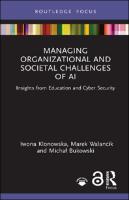
| Judul | Managing Organizational and Societal Challenges of AI : Insights from Education and Cyber Security / Walancik, Marek Klonowska, Iwona Bukowski, Micha? |
| Pengarang | Walancik, Marek Klonowska, Iwona Bukowski, Micha? |
| Penerbitan | London : Routledge, 2026 |
| Deskripsi Fisik | 136 p :Ilus |
| ISBN | 9781040597873 |
| Subjek | ARTIFICIAL INTELLIGENCE |
| Abstrak | Confronting how artificial intelligence (AI), the Internet of Things (IoT) and big data (BD) analytics are changing how we live, this book examines how these technologies can affect society at large and education and internal and external security in particular. Managing Organizational and Societal Challenges of AI: Insights from Education and Cyber Security addresses such questions as: What threats does AI pose to today's world, its internal security and broadly understood external security? Will AI-based education take away people's will to think and create? Why does AI inspire awe in some of us and fear in others? The book answers these questions by analysing how AI, IoT and data analytics are applied in security and education. This analysis begins with a literature survey of how these technologies bring both opportunities and threats that require responsible governance and global cooperation. The book underscores the necessity of resilience, adaptive strategies and innovative technologies to ensure preparedness for both traditional and non-traditional threats. It also emphasises that sustainable global security requires coordinated efforts, effective governance and multilateral cooperation. The book continues its analysis by examining the practical applications of AI in management, education and security. Featuring case studies, it highlights how AI supports hazard monitoring, emergency response and sustainable mobility, as well as personalising education, enhancing training and automating administrative tasks. Discussing the opportunities and challenges of AI in education, including the risks of over-reliance, reduced critical thinking and ethical concerns related to data privacy, the book concludes that AI not only offers significant benefits for improving efficiency, security and adaptability but also requires responsible regulation, investment and awareness of its limitations to ensure ethical and sustainable implementation. . |
| Bentuk Karya | Tidak ada kode yang sesuai |
| Target Pembaca | Tidak ada kode yang sesuai |
| Lokasi Akses Online |
https://library.oapen.org/viewer/web/viewer.html?file=/bitstream/handle/20.500.12657/113156/9781040597873.pdf?sequence=1&isAllowed=y |
| No Barcode | No. Panggil | Akses | Lokasi | Ketersediaan |
|---|---|---|---|---|
| 127126192 | 303.4834 Wal m | Baca Online | Perpustakaan Pusat - Online Resources Ebook |
Tersedia |
| Tag | Ind1 | Ind2 | Isi |
| 001 | INLIS000000000169646 | ||
| 005 | 20260811113422 | ||
| 007 | ta | ||
| 008 | 260811################|##########|#|## | ||
| 020 | # | # | $a 9781040597873 |
| 035 | # | # | $a 0010-0826000031 |
| 082 | # | # | $a 303.4834 |
| 084 | # | # | $a 303.4834 Wal m |
| 100 | 1 | # | $a Walancik, Marek |
| 245 | 1 | # | $a Managing Organizational and Societal Challenges of AI : $b Insights from Education and Cyber Security /$c Walancik, Marek Klonowska, Iwona Bukowski, Micha? |
| 260 | # | # | $a London :$b Routledge,$c 2026 |
| 300 | # | # | $a 136 p : $b Ilus |
| 520 | # | # | $a Confronting how artificial intelligence (AI), the Internet of Things (IoT) and big data (BD) analytics are changing how we live, this book examines how these technologies can affect society at large and education and internal and external security in particular. Managing Organizational and Societal Challenges of AI: Insights from Education and Cyber Security addresses such questions as: What threats does AI pose to today's world, its internal security and broadly understood external security? Will AI-based education take away people's will to think and create? Why does AI inspire awe in some of us and fear in others? The book answers these questions by analysing how AI, IoT and data analytics are applied in security and education. This analysis begins with a literature survey of how these technologies bring both opportunities and threats that require responsible governance and global cooperation. The book underscores the necessity of resilience, adaptive strategies and innovative technologies to ensure preparedness for both traditional and non-traditional threats. It also emphasises that sustainable global security requires coordinated efforts, effective governance and multilateral cooperation. The book continues its analysis by examining the practical applications of AI in management, education and security. Featuring case studies, it highlights how AI supports hazard monitoring, emergency response and sustainable mobility, as well as personalising education, enhancing training and automating administrative tasks. Discussing the opportunities and challenges of AI in education, including the risks of over-reliance, reduced critical thinking and ethical concerns related to data privacy, the book concludes that AI not only offers significant benefits for improving efficiency, security and adaptability but also requires responsible regulation, investment and awareness of its limitations to ensure ethical and sustainable implementation. . |
| 650 | # | # | $a ARTIFICIAL INTELLIGENCE |
| 700 | 0 | # | $a Bukowski, Micha? |
| 700 | 1 | # | $a Klonowska, Iwona |
| 856 | # | # | $a https://library.oapen.org/viewer/web/viewer.html?file=/bitstream/handle/20.500.12657/113156/9781040597873.pdf?sequence=1&isAllowed=y |
| 990 | # | # | $a 127126192 |
Content Unduh katalog
Karya Terkait :