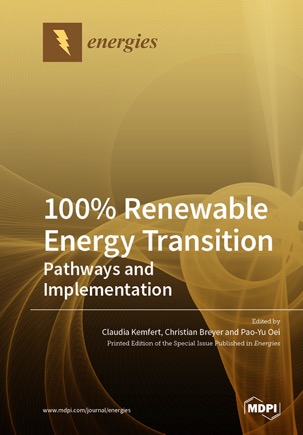
| Judul | 100% Renewable Energy Transition: Pathways and Implementation / Christian Breyer |
| Pengarang | Breyer, Christian Breyer, Christian Oei, Pao-Yu Kemfert, Claudia |
| Penerbitan | Basel : MDPI - Multidisciplinary Digital Publishing Institute, 2020 |
| Deskripsi Fisik | 356 :ill., ;25 cm |
| ISBN | 9783039280353 9783039280346 |
| Subjek | Renewable energy sources |
| Abstrak | Energy markets are already undergoing considerable transitions to accommodate new (renewable) energy forms, new (decentral) energy players, and new system requirements, e.g. flexibility and resilience. Traditional energy markets for fossil fuels are therefore under pressure, while not-yet-mature (renewable) energy markets are emerging. As a consequence, investments in large-scale and capital intensive (traditional) energy production projects are surrounded by high uncertainty, and are difficult to hedge by private entities. Traditional energy production companies are transforming into energy service suppliers and companies aggregating numerous potential market players are emerging, while regulation and system management are playing an increasing role. To address these increasing uncertainties and complexities, economic analysis, forecasting, modeling and investment assessment require fresh approaches and views. Novel research is thus required to simulate multiple actor interplays and idiosyncratic behavior. The required approaches cannot deal only with energy supply, but need to include active demand and cover systemic aspects. Energy market transitions challenge policy-making. Market coordination failure, the removal of barriers hindering restructuring and the combination of market signals with command-and-control policy measures are some of the new aims of policies.The aim of this Special Issue is to collect research papers that address the above issues using novel methods from any adequate perspective, including economic analysis, modeling of systems, behavioral forecasting, and policy assessment.The issue will include, but is not be limited to: Local control schemes and algorithms for distributed generation systems; Centralized and decentralized sustainable energy management strategies; Communication architectures, protocols and properties of practical applications; Topologies of distributed generation systems improving flexibility, efficiency and power quality; Practical issues in the control design and implementation of distributed generation systems; Energy transition studies for optimized pathway options aiming for high levels of sustainability |
| Bentuk Karya | Tidak ada kode yang sesuai |
| Target Pembaca | Tidak ada kode yang sesuai |
| Lokasi Akses Online |
https://www.mdpi.com/books/pdfview/book/1987 |
| No Barcode | No. Panggil | Akses | Lokasi | Ketersediaan |
|---|---|---|---|---|
| 308326192 | 333.794 Bre s | Dapat dipinjam | Perpustakaan Pusat - RBU KKB Ebook |
Tersedia
pesan |
| Tag | Ind1 | Ind2 | Isi |
| 001 | INLIS000000000170284 | ||
| 005 | 20260908071148 | ||
| 007 | ta | ||
| 008 | 260908################|##########|#|## | ||
| 020 | # | # | $a 9783039280346 |
| 020 | # | # | $a 9783039280353 |
| 035 | # | # | $a 0010-0926000578 |
| 082 | # | # | $a 333.794 |
| 084 | # | # | $a 333.794 Bre s |
| 100 | 0 | # | $a Breyer, Christian |
| 245 | 1 | # | $a 100% Renewable Energy Transition: Pathways and Implementation /$c Christian Breyer |
| 260 | # | # | $a Basel :$b MDPI - Multidisciplinary Digital Publishing Institute,$c 2020 |
| 300 | # | # | $a 356 : $b ill., ; $c 25 cm |
| 520 | # | # | $a Energy markets are already undergoing considerable transitions to accommodate new (renewable) energy forms, new (decentral) energy players, and new system requirements, e.g. flexibility and resilience. Traditional energy markets for fossil fuels are therefore under pressure, while not-yet-mature (renewable) energy markets are emerging. As a consequence, investments in large-scale and capital intensive (traditional) energy production projects are surrounded by high uncertainty, and are difficult to hedge by private entities. Traditional energy production companies are transforming into energy service suppliers and companies aggregating numerous potential market players are emerging, while regulation and system management are playing an increasing role. To address these increasing uncertainties and complexities, economic analysis, forecasting, modeling and investment assessment require fresh approaches and views. Novel research is thus required to simulate multiple actor interplays and idiosyncratic behavior. The required approaches cannot deal only with energy supply, but need to include active demand and cover systemic aspects. Energy market transitions challenge policy-making. Market coordination failure, the removal of barriers hindering restructuring and the combination of market signals with command-and-control policy measures are some of the new aims of policies.The aim of this Special Issue is to collect research papers that address the above issues using novel methods from any adequate perspective, including economic analysis, modeling of systems, behavioral forecasting, and policy assessment.The issue will include, but is not be limited to: Local control schemes and algorithms for distributed generation systems; Centralized and decentralized sustainable energy management strategies; Communication architectures, protocols and properties of practical applications; Topologies of distributed generation systems improving flexibility, efficiency and power quality; Practical issues in the control design and implementation of distributed generation systems; Energy transition studies for optimized pathway options aiming for high levels of sustainability |
| 650 | # | # | $a Renewable energy sources |
| 700 | 0 | # | $a Breyer, Christian |
| 700 | 0 | # | $a Kemfert, Claudia |
| 700 | 0 | # | $a Oei, Pao-Yu |
| 856 | # | # | $a https://www.mdpi.com/books/pdfview/book/1987 |
| 990 | # | # | $a 308326192 |
| 990 | # | # | $a 308326192 |
Content Unduh katalog
Karya Terkait :