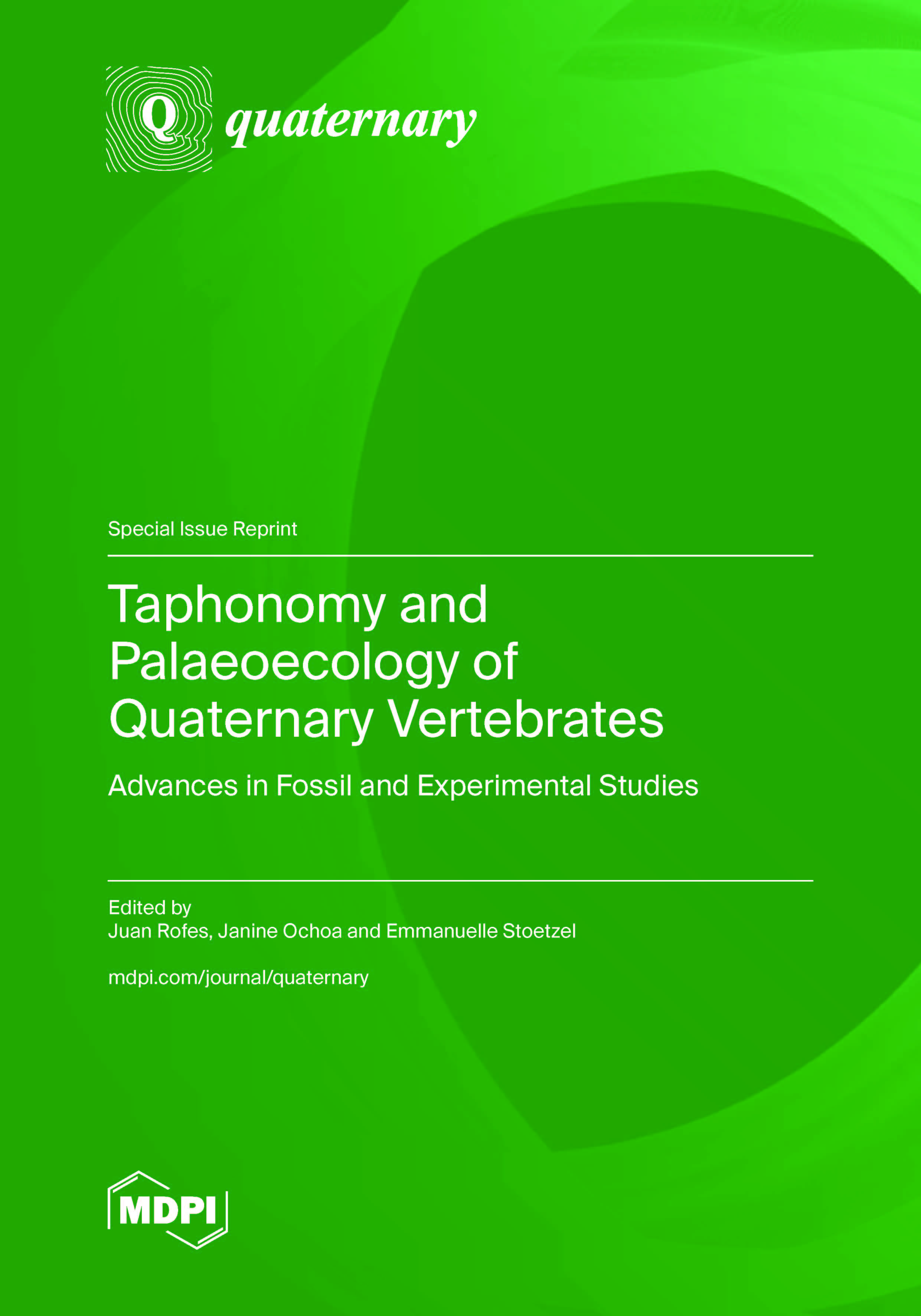
| Judul | Taphonomy and Palaeoecology of Quaternary Vertebrates / Juan Rofes |
| Pengarang | Juan Rofes Janine Ochoa Emmanuelle Stoetzel |
| Penerbitan | 4052 Basel, Switzerland : MDPI, 2025 |
| Deskripsi Fisik | 378 :ill |
| ISBN | 978-3-7258-4678-8 |
| Subjek | Biology & Life Sciences, Social Sciences, Arts & Humanities, Environmental & Earth Sciences |
| Catatan | "Summary Taphonomic studies allow for a better understanding of the processes of formation and preservation of fossil assemblages, and the identification of biases that can alter the palaeoenvironmental interpretations deduced from faunal lists. A taphonomic analysis of a fossil assemblage is, therefore, an essential prerequisite for subsequent palaeoecological studies. Palaeoecology, in turn, uses data from fossils to examine how organisms and their environments change throughout time. By studying patterns of evolution and extinction in the context of environmental change, palaeoecologists are able to examine concepts of vulnerability and resilience in species and environments at different geographic and temporal scales. The Quaternary period is well represented in geographically extensive and high-temporal-resolution records, and is of particular interest to human evolution. Vertebrate assemblages, whether accumulated by humans or non-human agents, are frequently well preserved in Quaternary palaeontologic |
| Bentuk Karya | Tidak ada kode yang sesuai |
| Target Pembaca | Tidak ada kode yang sesuai |
| Lokasi Akses Online |
https://www.mdpi.com/books/reprint/11309-taphonomy-and-palaeoecology-of-quaternary-vertebrates |
| No Barcode | No. Panggil | Akses | Lokasi | Ketersediaan |
|---|---|---|---|---|
| 111426192 | 560 Jua t | Baca Online | Perpustakaan Pusat - Online Resources Ebook |
Tersedia |
| Tag | Ind1 | Ind2 | Isi |
| 001 | INLIS000000000167551 | ||
| 005 | 20260326125755 | ||
| 007 | ta | ||
| 008 | 260326################|##########|#|## | ||
| 020 | # | # | $a 978-3-7258-4678-8 |
| 035 | # | # | $a 0010-0326000280 |
| 082 | # | # | $a 560 |
| 084 | # | # | $a 560 Jua t |
| 100 | 0 | # | $a Juan Rofes |
| 245 | 1 | # | $a Taphonomy and Palaeoecology of Quaternary Vertebrates /$c Juan Rofes |
| 260 | # | # | $a 4052 Basel, Switzerland :$b MDPI,$c 2025 |
| 300 | # | # | $a 378 : $b ill |
| 504 | # | # | $a "Summary Taphonomic studies allow for a better understanding of the processes of formation and preservation of fossil assemblages, and the identification of biases that can alter the palaeoenvironmental interpretations deduced from faunal lists. A taphonomic analysis of a fossil assemblage is, therefore, an essential prerequisite for subsequent palaeoecological studies. Palaeoecology, in turn, uses data from fossils to examine how organisms and their environments change throughout time. By studying patterns of evolution and extinction in the context of environmental change, palaeoecologists are able to examine concepts of vulnerability and resilience in species and environments at different geographic and temporal scales. The Quaternary period is well represented in geographically extensive and high-temporal-resolution records, and is of particular interest to human evolution. Vertebrate assemblages, whether accumulated by humans or non-human agents, are frequently well preserved in Quaternary palaeontological and archaeological deposits, especially in caves. In recent years, the number of and methods for taphonomic and palaeoecological analyses on Quaternary vertebrate assemblages have greatly developed, and here we highlight some works illustrating these advances, including the implementation of modern taphonomic referentials and experiments which are key to the adequate interpretation of fossil assemblages." |
| 650 | # | # | $a Biology & Life Sciences, Social Sciences, Arts & Humanities, Environmental & Earth Sciences |
| 700 | 0 | # | $a Emmanuelle Stoetzel |
| 700 | 0 | # | $a Janine Ochoa |
| 856 | # | # | $a https://www.mdpi.com/books/reprint/11309-taphonomy-and-palaeoecology-of-quaternary-vertebrates |
| 990 | # | # | $a 111426192 |
Content Unduh katalog