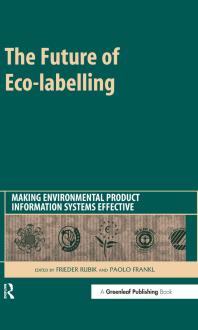
| Judul | The Future of Eco-Labelling : Making Environmental Product Information Systems Effective / Edited by: Frieder Rubik; Paolo Frankl |
| Pengarang | Rubik, Frieder Frankl, Paolo |
| Penerbitan | London : Taylor & Francis, 2005 |
| Deskripsi Fisik | 342 p. :ill |
| ISBN | 9781909493490 |
| Subjek | ENVIRONMENTAL SCIENCE -- ENVIRONMENTAL SUSTAINABILITY |
| Catatan | Eco-labelling is one of the key tools used by policy-makers in many parts of the world to encourage more sustainable production and consumption. By providing environmental information on products and services, eco-labels address both business users and consumers and range from mandatory approaches, such as required product declarations, to voluntary approaches, such as national eco-labels. Eco-labels can play an important role in environmental policy. They reward and promote environmentally superior goods and services and offer information on quality and performance with respect to issues such as health and energy consumption. Eco-labels fit well into a multi-stakeholder policy framework - as promulgated recently by the EU's integrated product policy (IPP) - since the development of criteria for labels and the acceptance in the market requires the involvement of a wide range of different parties, from government and business, to consumers and environmental organisations. However, many eco-labelling schemes ha |
| Bentuk Karya | Tidak ada kode yang sesuai |
| Target Pembaca | Tidak ada kode yang sesuai |
| Lokasi Akses Online |
https://ebookcentral.proquest.com/lib/unair-ebooks/detail.action?docID=1741757 |
| No Barcode | No. Panggil | Akses | Lokasi | Ketersediaan |
|---|---|---|---|---|
| 602125292 | 363.7394 Fut | Baca Online | Perpustakaan Pusat - Online Resources Ebook |
Tersedia |
| Tag | Ind1 | Ind2 | Isi |
| 001 | INLIS000000000164456 | ||
| 005 | 20250910020344 | ||
| 007 | ta | ||
| 008 | 250910################|##########|#|## | ||
| 020 | # | # | $a 9781909493490 |
| 035 | # | # | $a 0010-0925000106 |
| 082 | # | # | $a 363.7394 |
| 084 | # | # | $a 363.7394 Fut |
| 245 | # | # | $a The Future of Eco-Labelling : $b Making Environmental Product Information Systems Effective /$c Edited by: Frieder Rubik; Paolo Frankl |
| 260 | # | # | $a London :$b Taylor & Francis,$c 2005 |
| 300 | # | # | $a 342 p. : $b ill |
| 505 | # | # | $a Eco-labelling is one of the key tools used by policy-makers in many parts of the world to encourage more sustainable production and consumption. By providing environmental information on products and services, eco-labels address both business users and consumers and range from mandatory approaches, such as required product declarations, to voluntary approaches, such as national eco-labels. Eco-labels can play an important role in environmental policy. They reward and promote environmentally superior goods and services and offer information on quality and performance with respect to issues such as health and energy consumption. Eco-labels fit well into a multi-stakeholder policy framework - as promulgated recently by the EU's integrated product policy (IPP) - since the development of criteria for labels and the acceptance in the market requires the involvement of a wide range of different parties, from government and business, to consumers and environmental organisations. However, many eco-labelling schemes have had troubled histories, and questions have been raised about their effectiveness. So, are eco-labels an effective tool to foster the development, production, sale and use of products and to provide consumers with good information about the environmental impacts of those products? Is eco-labelling useful to business as a marketing tool? What factors contribute to the development of successful schemes? More than ten years after its establishment, can the EU Flower be considered a success? Are national eco-labels such as the German Blue Angel and the Norwegian White Swan more effective? Should eco-labels be harmonised? Are eco-labels achieving their original aim of fostering sustainable production and consumption? For which product groups are ISO type I eco-labels appropriate and inappropriate? Are other labels, such as mandatory, ISO type II and ISO type III labels more effective in some cases? Are eco-labels focusing on the main environmental policy targets or just on "low-hanging fruit"? Are eco-labels really linked to other tools of IPP? The Future of Eco-labelling provides answers to all of these questions. Based on a major EU research exercise, the book plots a course for policy-makers to address some of the historic problems with eco-labelling, to learn what works and what doesn't and to move forward with schemes that can make a real difference to sustainable production and consumption.The book analyses the conditions under which eco-labelling schemes-both mandatory and voluntary-are or can become an efficient and effective tool to achieve given objectives; assesses previous experiences with eco-labels in different European countries and the relationship of these schemes with business strategies, IPP and market conditions; defines strategies aimed at linking eco-labels with other IPP measures; explores how eco-labels can be used to encourage sustainable consumption patterns, create green markets, foster innovation and development of green products and services, and implement multi-stakeholder initiatives; and sets out detailed recommendations for the future of eco-labelling.The book will be required reading for policy-makers, businesses involved with eco-labelling schemes and researchers interested in the development of sustainable production and consumption and IPP worldwide. |
| 650 | # | # | $a ENVIRONMENTAL SCIENCE -- ENVIRONMENTAL SUSTAINABILITY |
| 700 | 1 | # | $a Frankl, Paolo |
| 700 | 1 | # | $a Rubik, Frieder |
| 856 | # | # | $a https://ebookcentral.proquest.com/lib/unair-ebooks/detail.action?docID=1741757 |
| 990 | # | # | $a 602125292 |
Content Unduh katalog
Karya Terkait :