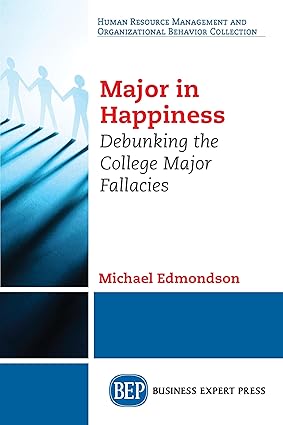
| Judul | Major in Happiness: Debunking the College Major Fallacies |
| Pengarang | Edmondson, Michael |
| Penerbitan | New Jersey, USA : Business Expert Press, 2016 |
| Deskripsi Fisik | 221 :ill |
| ISBN | 9781631573934 |
| Subjek | BUSINESS & ECONOMICS / HUMAN RESOURCES, PERSONNEL MANAGEMENT, SOCIAL SCIENCES, EDUCATION, HIGHER EDUCATION |
| Abstrak | The preconceptions and suspicions about how things operate in today's challenging global marketplace often compel people to forge correlations with causations without any substantial evidence. Unfortunately, this flawed thinking is the foundation upon which many students declare their undergraduate major. With the repayment of college loans as a paramount issue for students and their families, the major is often viewed as the stepping stone for a career that can repay those loans instead of the first step to a meaningful life based on leadership, purpose, and service. Students should declare a major that makes them happy. Doing so substantially increases their chances of pursuing careers paths that ignite their passion, identify with their purpose, and spark a commitment to lifelong learning. All too often, however, students are exposed to the myopic valuable versus useless paradigm of decision-making process when it comes to declaring a major. According to this paradigm, a "valuable" major is useful, can teach a specific skill, and provides one with a lifetime of employment and riches. Accounting, marketing, engineering, and computer science are just a few examples. A "worthless" major, on the other hand, is more intellectual and therefore has little, or no, practical application for employment purposes. Majors that generally fall into this category include history, English, philosophy, and sociology among others. This dichotomy between the valuable versus useless majors is based on flawed mental models and ingrained assumptions about how the world works that lead to a series of fallacies surrounding the college major. Major in Happiness: Debunking the College Major Fallacies examines a variety of assumptions prevalent in the mental models of undergraduates, parents, educators, higher education leaders, administrators, and policymakers that cause people to fall into a series of mental traps when selecting a major. Divided into three parts, this publication presents a situational analysis on choosing a college major, dissects the mental models and traps people rely on, and offers a variety of assessments that can help increase one's self-awareness prior to declaring a major. |
| Bentuk Karya | Tidak ada kode yang sesuai |
| Target Pembaca | Tidak ada kode yang sesuai |
| Lokasi Akses Online |
https://portal.igpublish.com/iglibrary/search/BEPB0000446.html |
| No Barcode | No. Panggil | Akses | Lokasi | Ketersediaan |
|---|---|---|---|---|
| 086515292 | 378.199 Edm m | Baca Online | Perpustakaan Pusat - Online Resources Ebook |
Tersedia |
| Tag | Ind1 | Ind2 | Isi |
| 001 | INLIS000000000158824 | ||
| 005 | 20250310112619 | ||
| 007 | ta | ||
| 008 | 250310################|##########|#|## | ||
| 020 | # | # | $a 9781631573934 |
| 035 | # | # | $a 0010-0325000443 |
| 082 | # | # | $a 378.199 |
| 084 | # | # | $a 378.199 Edm m |
| 100 | 0 | # | $a Edmondson, Michael |
| 245 | 1 | # | $a Major in Happiness: Debunking the College Major Fallacies |
| 260 | # | # | $a New Jersey, USA :$b Business Expert Press,$c 2016 |
| 300 | # | # | $a 221 : $b ill |
| 520 | # | # | $a The preconceptions and suspicions about how things operate in today's challenging global marketplace often compel people to forge correlations with causations without any substantial evidence. Unfortunately, this flawed thinking is the foundation upon which many students declare their undergraduate major. With the repayment of college loans as a paramount issue for students and their families, the major is often viewed as the stepping stone for a career that can repay those loans instead of the first step to a meaningful life based on leadership, purpose, and service. Students should declare a major that makes them happy. Doing so substantially increases their chances of pursuing careers paths that ignite their passion, identify with their purpose, and spark a commitment to lifelong learning. All too often, however, students are exposed to the myopic valuable versus useless paradigm of decision-making process when it comes to declaring a major. According to this paradigm, a "valuable" major is useful, can teach a specific skill, and provides one with a lifetime of employment and riches. Accounting, marketing, engineering, and computer science are just a few examples. A "worthless" major, on the other hand, is more intellectual and therefore has little, or no, practical application for employment purposes. Majors that generally fall into this category include history, English, philosophy, and sociology among others. This dichotomy between the valuable versus useless majors is based on flawed mental models and ingrained assumptions about how the world works that lead to a series of fallacies surrounding the college major. Major in Happiness: Debunking the College Major Fallacies examines a variety of assumptions prevalent in the mental models of undergraduates, parents, educators, higher education leaders, administrators, and policymakers that cause people to fall into a series of mental traps when selecting a major. Divided into three parts, this publication presents a situational analysis on choosing a college major, dissects the mental models and traps people rely on, and offers a variety of assessments that can help increase one's self-awareness prior to declaring a major. |
| 650 | # | # | $a BUSINESS & ECONOMICS / HUMAN RESOURCES, PERSONNEL MANAGEMENT, SOCIAL SCIENCES, EDUCATION, HIGHER EDUCATION |
| 856 | # | # | $a https://portal.igpublish.com/iglibrary/search/BEPB0000446.html |
| 990 | # | # | $a 086515292 |
Content Unduh katalog
Karya Terkait :