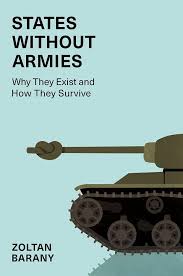
| Judul | States without Armies : Why They Exist and How They Survive / Barany, Zoltan |
| Pengarang | Barany, Zoltan |
| Penerbitan | New York : Oxford University Press, 2026 |
| Deskripsi Fisik | 256 :ilus |
| ISBN | 9780197679708 |
| Subjek | DEMILITARIZATION |
| Abstrak | Is it possible for a state to exist without a military in an increasingly divided and heavily militarized world? The answer is “yes.” Twenty-one sovereign countries do not maintain standing armies. Many of them are small island states and the majority chose not to create armed forces upon attaining independence. Demilitarization, the act of abolishing an extant army, occurs much more infrequently because it clashes with the interests of powerful organizations, especially the armed forces themselves. Some European mini states scrapped their armies centuries ago. But two Central American countries, Costa Rica and Panama, and two Caribbean Island nations, Dominica and Grenada, dispensed with their militaries after World War II. Armyless states share some important commonalities: (1) The decision to demilitarize or not to have an army always follows a pivotal moment (military coup, foreign invasion, reaching independence) in history; (2) they have bilateral security arrangements and/or an alliance with a regional hegemon; (3) they have not been attacked or invaded; (4) they maintain public safety and border security organizations; (5) they are consolidated democracies; and (6) they are more prosperous and spend more on healthcare, education, and socioeconomic development than their neighbors with armed forces. While States without Armies engages all twenty-one demilitarized states, it focuses on the experiences of Costa Rica, Iceland, Mauritius, Panama, and the Solomon Islands. The book’s ambition is to introduce a general audience to the world of non-militarized states and contribute to the peace studies, small states, and international affairs literatures. |
| Bentuk Karya | Tidak ada kode yang sesuai |
| Target Pembaca | Tidak ada kode yang sesuai |
| Lokasi Akses Online |
https://library.oapen.org/bitstream/handle/20.500.12657/118384/9780197679678.pdf?sequence=1&isAllowed=y |
| No Barcode | No. Panggil | Akses | Lokasi | Ketersediaan |
|---|---|---|---|---|
| 4652 | 355.033 Bar s | Baca Online | Perpustakaan Pusat - Online Resources Ebook |
Tersedia |
| Tag | Ind1 | Ind2 | Isi |
| 001 | INLIS000000000171297 | ||
| 005 | 20261022032754 | ||
| 007 | ta | ||
| 008 | 261022################|##########|#|## | ||
| 020 | # | # | $a 9780197679708 |
| 035 | # | # | $a 0010-1026000692 |
| 082 | # | # | $a 355.033 |
| 084 | # | # | $a 355.033 Bar s |
| 100 | 1 | # | $a Barany, Zoltan |
| 245 | 1 | # | $a States without Armies : $b Why They Exist and How They Survive /$c Barany, Zoltan |
| 260 | # | # | $a New York :$b Oxford University Press,$c 2026 |
| 300 | # | # | $a 256 : $b ilus |
| 520 | # | # | $a Is it possible for a state to exist without a military in an increasingly divided and heavily militarized world? The answer is “yes.” Twenty-one sovereign countries do not maintain standing armies. Many of them are small island states and the majority chose not to create armed forces upon attaining independence. Demilitarization, the act of abolishing an extant army, occurs much more infrequently because it clashes with the interests of powerful organizations, especially the armed forces themselves. Some European mini states scrapped their armies centuries ago. But two Central American countries, Costa Rica and Panama, and two Caribbean Island nations, Dominica and Grenada, dispensed with their militaries after World War II. Armyless states share some important commonalities: (1) The decision to demilitarize or not to have an army always follows a pivotal moment (military coup, foreign invasion, reaching independence) in history; (2) they have bilateral security arrangements and/or an alliance with a regional hegemon; (3) they have not been attacked or invaded; (4) they maintain public safety and border security organizations; (5) they are consolidated democracies; and (6) they are more prosperous and spend more on healthcare, education, and socioeconomic development than their neighbors with armed forces. While States without Armies engages all twenty-one demilitarized states, it focuses on the experiences of Costa Rica, Iceland, Mauritius, Panama, and the Solomon Islands. The book’s ambition is to introduce a general audience to the world of non-militarized states and contribute to the peace studies, small states, and international affairs literatures. |
| 650 | # | # | $a DEMILITARIZATION |
| 856 | # | # | $a https://library.oapen.org/bitstream/handle/20.500.12657/118384/9780197679678.pdf?sequence=1&isAllowed=y |
| 990 | # | # | $a 4652 |
Content Unduh katalog