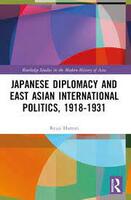
| Judul | Japanese Diplomacy and East Asian International Politics, 1918–1931 / Ryuji Hattor |
| Pengarang | Ryuji Hattor |
| Penerbitan | Routledge, 2024 |
| ISBN | https://doi.org/10.4324/9781032675985 |
| Subjek | JAPANESE DIPLOMACY INTERNATIONAL POLITICS INTERNATIONAL RELATIONS |
| Abstrak | This book provides an overall picture of East Asian international politics during the early interwar period and examines the various foreign policy trends of the major powers involved, including Japan, China, Britain, the United States, and the Soviet Union. Based on extensive original research, it posits that East Asia experienced four waves of international change during the interwar period: the transition to the post-World War I international order; the appearance of Nationalist China and the Soviet Union as actors in East Asian international politics; the Japanese invasion of Manchuria; and Japanese implementation of the North China Buffer State Strategy. It considers the new challenges brought about by each of these waves, how the powers – particularly Japan, Britain, and the United States – were able to meet these challenges by working together, and how this became more difficult as time went on. It argues that the Washington System – the international order established at the 1921–1922 Washington Naval Conference – was not a break with the past, as is frequently argued, on account of new forms of foreign policy, including the ideological approaches of the United States and the Soviet Union, but that rather spheres of influence diplomacy continued as before. In addition, in discussing Japanese foreign policy, the book provides a comprehensive picture of the diversity of views towards China among Japanese actors and the ways these shifted over time. |
| Bentuk Karya | Tidak ada kode yang sesuai |
| Target Pembaca | Tidak ada kode yang sesuai |
| Lokasi Akses Online |
https://oer.unair.ac.id/files/original/d071513b0e055609b4246fc9357c338a.pdf https://www.taylorfrancis.com/books/oa-edit/10.4324/9781003222637/critical-ancient-world-studies-mathura-umachandran-marchella-ward?context=ubx&refId=283c3b42-77ea-4c36-be1a-07c005af0a20 |
| No Barcode | No. Panggil | Akses | Lokasi | Ketersediaan |
|---|---|---|---|---|
| 232225192 | 327.52 RYU j | Baca Online | Perpustakaan Pusat - Online Resources Ebook |
Tersedia |
| Tag | Ind1 | Ind2 | Isi |
| 001 | INLIS000000000165811 | ||
| 005 | 20251230035932 | ||
| 007 | ta | ||
| 008 | 251230################|##########|#|## | ||
| 020 | # | # | $a https://doi.org/10.4324/9781032675985 |
| 035 | # | # | $a 0010-1225000456 |
| 082 | # | # | $a 327.52 |
| 084 | # | # | $a 327.52 RYU j |
| 100 | 0 | # | $a Ryuji Hattor |
| 245 | 1 | # | $a Japanese Diplomacy and East Asian International Politics, 1918–1931 /$c Ryuji Hattor |
| 260 | # | # | :$b Routledge,$c 2024 |
| 520 | # | # | $a This book provides an overall picture of East Asian international politics during the early interwar period and examines the various foreign policy trends of the major powers involved, including Japan, China, Britain, the United States, and the Soviet Union. Based on extensive original research, it posits that East Asia experienced four waves of international change during the interwar period: the transition to the post-World War I international order; the appearance of Nationalist China and the Soviet Union as actors in East Asian international politics; the Japanese invasion of Manchuria; and Japanese implementation of the North China Buffer State Strategy. It considers the new challenges brought about by each of these waves, how the powers – particularly Japan, Britain, and the United States – were able to meet these challenges by working together, and how this became more difficult as time went on. It argues that the Washington System – the international order established at the 1921–1922 Washington Naval Conference – was not a break with the past, as is frequently argued, on account of new forms of foreign policy, including the ideological approaches of the United States and the Soviet Union, but that rather spheres of influence diplomacy continued as before. In addition, in discussing Japanese foreign policy, the book provides a comprehensive picture of the diversity of views towards China among Japanese actors and the ways these shifted over time. |
| 650 | # | # | $a INTERNATIONAL POLITICS |
| 650 | # | # | $a INTERNATIONAL RELATIONS |
| 650 | # | # | $a JAPANESE DIPLOMACY |
| 856 | # | # | $a https://oer.unair.ac.id/files/original/d071513b0e055609b4246fc9357c338a.pdf |
| 856 | # | # | $a https://www.taylorfrancis.com/books/oa-edit/10.4324/9781003222637/critical-ancient-world-studies-mathura-umachandran-marchella-ward?context=ubx&refId=283c3b42-77ea-4c36-be1a-07c005af0a20 |
| 990 | # | # | $a 232225192 |
Content Unduh katalog
Karya Terkait :